


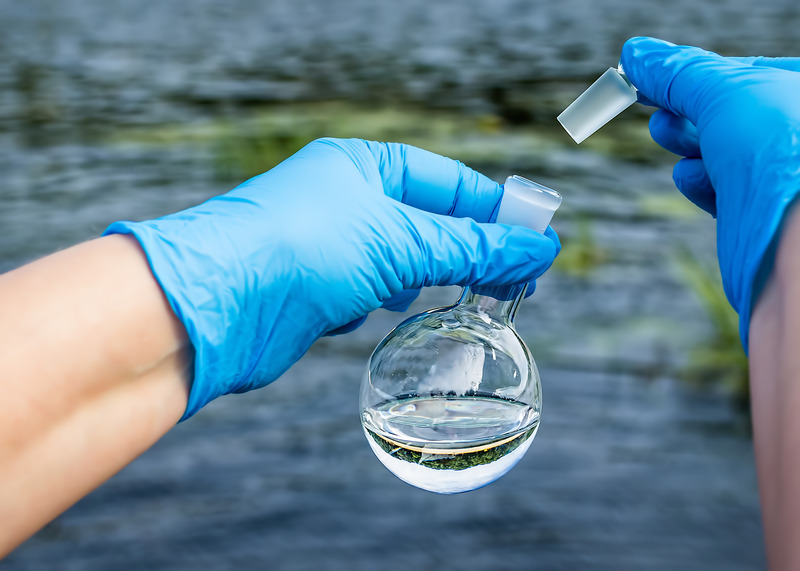
Micropollutants are pollutants that can have negative effects on drinking water production and aquatic ecosystems, even if they are only present in small quantities in the water. Examples of micropollutants include pharmaceutical residues, industrial chemicals and pesticides.
In February 2020, the Conference of Rhine Ministers in Amsterdam adopted the ‘Rhine 2040’ programme. This programme set the goal of reducing discharges of micropollutants by at least 30% by 2040.
In order to be able to review the target regularly, a monitoring and evaluation system was developed and published in 2022. It provides for the annual monitoring of over 50 substances that are representative of pollutants in the environment. On the Rhine and its major tributaries, the substances from wastewater treatment plants and industry are measured at 12 measuring stations. For emissions from agriculture, a further 50 measuring stations have been defined on smaller tributaries.
The ICPR Technical Report No. 312, published in December 2025, is the first interim report for the period 2016–2023. The aim of the report is to identify trends and review the methodology.
‘First trends show that the countries in the Rhine river basin are on the right track in reducing micropollutants. They must now take further measures to achieve the reduction target by 2040.’, states ICPR President Miriam Haritz.
Friederike Vietoris, Chair of the ICPR Working Group on Water Quality and Emissions, adds: ‘Given the demanding nature of the task, the monitoring and evaluation system has proven its worth. The task now is to optimise the methodology by the time of the next interim report at the next Rhine Ministerial Conference in Luxembourg at the end of 2027 in order to further increase its informative value.’
Summary of the results:
There has been a positive development in the emissions area of wastewater treatment plants. A significant reduction was achieved for 8 of 21 indicator substances (e.g. for the sweetener acesulfame) at all measuring points. For 9 substances, the picture was not uniform. An increase was observed for four substances (e.g. the antibiotic sulfamethoxazole). In recent years, numerous wastewater treatment plants have been upgraded with a fourth treatment stage. Further upgrades are planned, partly as a result of the new EU Urban Waste Water Treatment Directive. This will lead to further improvements in the coming years.
With regard to the second interim report, the data situation for the emissions area of industry must be significantly improved by 2027. The following statements on trends are therefore subject to reservations, but they do provide a first impression. A significant decline was observed for 5 of 12 indicator substances, including the solvent 1,4-dioxane. The picture is mixed for seven substances: a significant reduction was measured at some measuring stations, while at others the reduction was insufficient and in some cases there was even an increase (e.g. for perfluorooctanoic acid, which is used in the manufacture of non-stick coatings). The states in the Rhine river basin have undertaken to make further efforts in this area. The new ‘INDUSTRY’ expert group set up by the ICPR in 2023 will support them in this endeavour.
Due to insufficient data and methodological challenges, it is not yet possible to carry out an overall assessment for the emissions area of agriculture. Measurements should be continued in order to generate sufficiently long data series, and the list of indicator substances should be reviewed.
Contact for queries
Marc Daniel Heintz (Executive Secretary)
marcdaniel.heintz(at)iksr.de
Background information on the ICPR
In the International Commission for the Protection of the Rhine (ICPR), Switzerland, France, Germany, the Netherlands, Luxembourg and the European Union have been working together for mor than 70 years on the basis of a convention under international law to reconcile the diverse uses and protection of water bodies. With a view to implementing European directives, the cross-border cooperation was extended to Austria, Liechtenstein and the Belgian region Wallonia.
At present (2023-2025), Miriam Haritz from Germany holds the ICPR presidency. She and the different ICPR groups are supported by the international staff of the permanent secretariat in Koblenz (Germany).
See also www.iksr.org/en and LinkedIn