



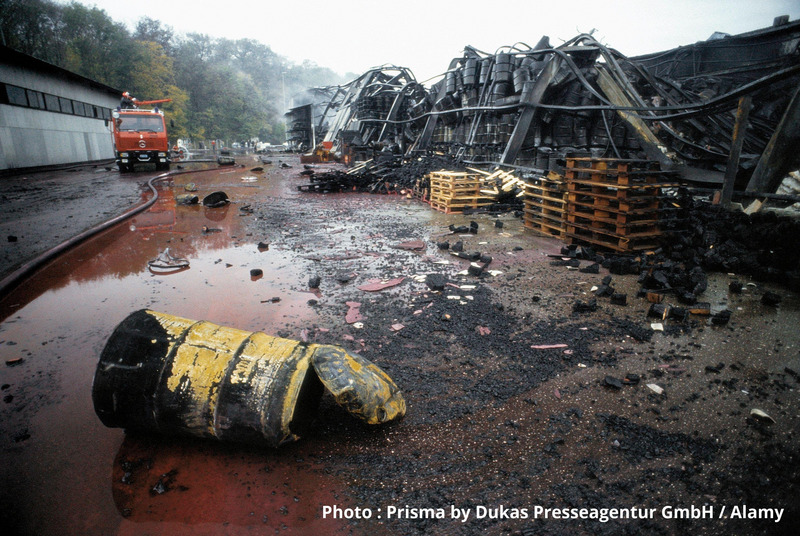
Forty years ago today, on 1 November 1986, tonnes of pesticides were released into the Rhine following a major fire at a chemical factory near Basel. The so-called Sandoz accident polluted the river for hundreds of kilometres and caused a mass mortality of fish and other aquatic life. In response, the riparian countries jointly set the course for even stronger water protection – an approach that remains in place to this day.
In the wake of the environmental disaster, the countries in the Rhine basin set themselves the goal of significantly and sustainably improving the water quality of the Rhine and enhancing the river’s value as a natural habitat. They built further wastewater treatment plants, optimised accident prevention measures, restored watercourses to a more natural state, and improved the connectivity between the main course of the Rhine, its tributaries and the North Sea.
International cooperation within the framework of the International Commission for the Protection of the Rhine (ICPR), founded in 1950, has been steadily expanded since then. Adaptation to climate change, including the management of floods and droughts, is now one of its tasks.
Cleaner water, better habitats
Water quality has improved significantly compared with the period before the accident. Thanks to the upgrading of wastewater treatment plants, there are now up to 90 per cent fewer heavy metals and up to 50 per cent less nitrate and phosphorus in the Rhine. The reduction in nutrient pollution in the Rhine has led to more natural ecosystems and has restored biodiversity. The Rhine now serves as a habitat for more than 70 species of fish once again, and species that had previously become extinct in the river have returned, some of them as part of joint reintroduction efforts (salmon, allis shad).
Technological advances are helping to tackle current challenges such as micropollutants, for example from pharmaceutical residues. Innovative non-target screening covers a wider range of substances than standard water monitoring.
Many wastewater treatment plants are currently being upgraded or will be in the near future with an additional treatment stage, enabling them to remove pollutants even more effectively. One example is the Basel wastewater treatment plant, which was officially inaugurated on 18 April 2026 following a construction period of around ten years and an investment of approximately €350 million. It is now one of the most modern wastewater treatment plants in Europe.
Cooperation without borders
Meanwhile, the water in the Rhine is not only cleaner but also better protected against accidents. Thanks to the ICPR’s international warning and alarm plan, the countries bordering the Rhine can quickly inform each other and respond should an accident occur. A Rhine flow time model estimates the propagation time of pollutant plumes and enables improved crisis management in the event of accident-related pollution. The model will soon be updated as part of an EU LIFE project.
These successes are based on many years of transboundary cooperation in the Rhine basin. Convinced that water pollution, flooding and migratory fish know no borders, the countries are setting themselves joint and ambitious goals. They are implementing appropriate measures on the ground and regularly reviewing progress.
In order to tackle the remaining challenges and transform the Rhine into a climate-resilient and sustainably managed river, the countries in the Rhine river basin have adopted the ‘Rhine 2040’ programme.
Contact for queries
Marc Daniel Heintz (Executive secretary)
marcdaniel.heintz(at)iksr.de
0049-261-94252-19
Background information on the ICPR
In the International Commission for the Protection of the Rhine (ICPR), Switzerland, France, Germany, the Netherlands, Luxembourg and the European Union have been working together since 1950 on the basis of a convention under international law to reconcile the diverse uses and protection of water bodies. With a view to implementing European directives, the cross-border cooperation was extended to Austria, Liechtenstein and the Belgian region Wallonia.
An international secretariat based in Koblenz (Germany) supports the president and the bodies of the ICPR.
See also www.iksr.org/en and https://www.linkedin.com/company/international-commission-for-the-protection-of-the-rhine/.